2025 geocompx report: advancing spatial data analysis across languages
The geocompx project provides open-source, open-access resources for learning and teaching about geocomputation in multiple programming languages. The year 2025 was special for the project, marked by various milestones and progress. This post summarizes the key updates from 2025, outlines the current work in progress, and speaks on how you can support the project.
Books published
In 2025, we published two major books as part of the geocompx project:
- Geocomputation with R (2nd edition): This updated edition of the book on geocomputation in R with many parts rewritten and new content added. See our blog post for more details.
- Geocomputation with Python: This is the first edition of the book on geocomputation in Python, covering various aspects of spatial data analysis, from understanding spatial objects, by operations on them, to making maps, using popular Python libraries.
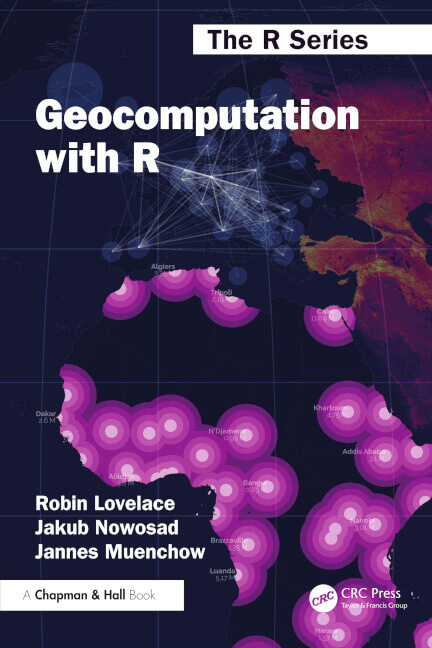
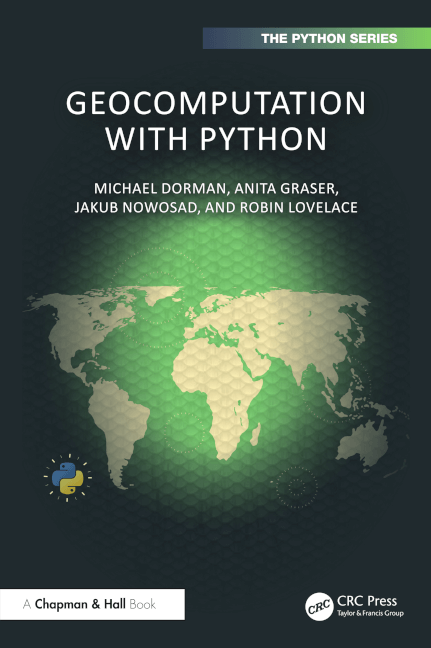
Both books are available online for free, and printed copies can be purchased from various retailers.
This year is also marked by the release of the Japanese translation of Geocomputation with R by Baba Yoshihiko1. You can find it at https://r.geocompx.org/jp/.
Blog posts
We published a six-part blog post series on spatial machine learning with R in 2025. It presents and compares various machine learning frameworks in R, caret, tidymodels, and mlr3. It also showcases specialized R packages for spatial machine learning and spatial cross-validation. All blog posts include reproducible code examples and are available at https://geocompx.org/post/2025/sml-bp1/.

Work in progress
We are currently working on two new books as part of the geocompx project. It includes “Spatial Data Visualization with tmap: A Practical Guide to Thematic Mapping in R” and “Geocomputation with Julia”. The tmap book is more than halfway done, and the first three out of five parts are available online at https://tmap.geocompx.org/2. The Julia book is in the early stages of development, with the first draft of the initial chapters available at https://jl.geocompx.org/. You may also get involved in the development of these books by contributing code, examples, or reporting issues to the respective GitHub repositories: https://github.com/geocompx/tmap/ and https://github.com/geocompx/geocompjl/.

Support the project
We would like to thank everyone who has supported the geocompx project so far, either by sharing it with others, contributing code or content, or providing any type of support. During the year, we got financial contributions via GitHub Sponsors and Stripe donation3. After various expenses, we received a total of 75 EUR in 2025. This money was used to cover domain costs for the project and send a few copies of the book to readers. We had several issues with the Stripe donation platform4, and thus, we have now moved to Liberapay as the main donation platform.
We encourage you to support the geocompx project financially if you find our resources useful.
All the best in 2026!
Footnotes
Reuse
Citation
@online{nowosad2025,
  author = {Nowosad, Jakub},
  title = {2025 Geocompx Report: Advancing Spatial Data Analysis Across
    Languages},
  date = {2025-12-21},
  url = {https://geocompx.org/post/2025/updates-2025/},
  langid = {en}
}